
Expect 2–3 Sessions for Scar Cover Up Tattoos and Medical Clearance
Yes, most fully healed, stable scars can be tattooed, either through a decorative cover-up that uses standard tattoo ink and design, or through paramedical camouflage that implants skin-toned pigment to blend the scar into surrounding skin. The exception is any scar that’s still red, painful, draining, raised, or actively changing shape. A dermatologist should look at those before anyone picks up a needle. Beyond that, the job is finding an experienced artist who patch-tests, plans for touch-ups, and treats scar tissue differently than regular skin.
TL;DR:
Fully healed, flat, and pale scars are the safest and easiest to tattoo, while raised or red scars should be evaluated by a dermatologist first.
Artists must have specific scar experience, use patch tests, and follow strict hygiene protocols to achieve reliable and safe results.
Camouflage works best for depigmented, smooth scars, whereas decorative cover-ups suit textured or darker scars with more surface irregularities.
Expect increased pain, uneven pigment uptake, and multiple touch-ups for tattooing over scar tissue, with thorough aftercare vital to avoid infection or pigment loss.
Patience in scheduling and staging sessions ensures better longevity and appearance, as scars heal independently on their own timelines.
Table of Contents
Which Scars Are Good Candidates for a Scar Cover Up Tattoo?
Flat, pale, fully matured scars are the easiest and safest to tattoo. The skin is stable, ink sits evenly, and the artist can work with a predictable surface. Keloids and hypertrophic scars are a different story. Because they’re still actively forming collagen, tattooing can trigger renewed inflammation and make them raise further, which is why keloid treatment guides push toward steroid injections, silicone sheets, or pressure devices well before any cosmetic ink comes into play, according to the American Academy of Dermatology’s keloid treatment guidance.
Burn scars and graft sites need extra scrutiny since skin texture and sensation can vary across the same scar. Atrophic scars and stretch marks, the sunken or streaky kind, usually tattoo fine as long as they’re no longer pink or tender.
A few checks tell you where your scar stands:
Color: white, tan, or skin-toned is ready; red or purple usually is not.
Texture: flexible and pliable is good; hard, tight, or still thickening is not.
Sensation: no pain or itching at rest.
Drainage: none, ever.
Internal remodeling in a scar can continue long after the surface looks closed, so waiting matters more than it seems. When a scar looks unusual, changes shape, or you’re not sure what it even is, get it examined first. Dermatologists can catch things that aren’t obvious to the eye, and the American Academy of Dermatology specifically recommends this step before any cosmetic scar work.
How Do You Pick the Right Artist for Scar Work?
Not every skilled tattoo artist has scar experience, and that gap shows up in the final result. Scar tissue behaves differently under the needle: it can accept ink unevenly, heal slower, and scar deeper if handled carelessly.
Before booking, work through this:
Ask to see healed scar cover-up work, not just fresh photos. Healed results tell you how the ink actually settled over months, not days.
Ask directly about scar experience and how many similar cases they’ve handled.
Confirm patch-test practice. A responsible artist tests a small area first and watches for reaction before committing to the full piece.
Ask about touch-up policy. Scar work almost always needs at least one follow-up session.
Check sterilization and needle protocols. Single-use needles and visible sterile setup are non-negotiable.
Discuss design approach in the consult and whether they draw freehand over your scar’s contours or rely on a stencil.
If you have a personal or family history of keloids, or scarring that healed unpredictably in the past, get medical clearance before your consult, not after you’ve already picked a design.
Pro Tip: Bring your dermatologist’s notes to the consultation if you have them. A good artist will actually want to read them before touching your skin.
Decorative Cover-Up or Paramedical Camouflage: Which Fits Your Scar?
The two approaches solve different problems. Decorative cover-ups use regular tattoo ink and artistic design to visually redirect attention away from a scar’s shape or color. Paramedical camouflage instead implants custom-mixed, skin-toned pigment directly into flat, depigmented scars to blend them into the surrounding skin, often over two to three sessions to get the tone right.
Textured or noticeably dark scars usually do better with a decorative cover-up, because texture tends to show through even flawless linework. Flat, depigmented scars without much raised texture are the better fit for camouflage work, since there’s nothing for a design to visually “explain.”
A few design rules make a real difference:
Busy, organic patterns (florals, abstract linework, texture-heavy blackwork) hide irregular surface better than fine, delicate lines.
Let the scar’s raised or sunken texture become part of the composition instead of fighting it.
Some clients combine both techniques, using camouflage pigment as a base layer under a decorative piece.
In some cases, leaving part of a scar visible is the better aesthetic choice, especially with scars that carry personal significance.
What Should You Expect From Pain, Healing, and Aftercare?
Tattooing over scar tissue tends to hurt more than tattooing regular skin, since nerve endings can be denser or more sensitive depending on how the scar healed. Numbing options and shorter sessions are common ways artists manage that.
Ink uptake on scar tissue is less predictable than on unscarred skin. A doctor-reviewed guide from Healthline notes that touch-ups are common because pigment can settle unevenly the first time around, and full healing needs to happen before anyone can judge the final look.
Watch for these warning signs, which need medical attention rather than a wait-and-see approach:
Spreading redness, warmth, or swelling beyond the tattooed area
Pus or foul-smelling drainage
Fever or chills
A rash or hives suggesting an allergic reaction to pigment
New raising or thickening at the scar site
Micropigmentation in particular carries documented risks, including granulomas, keloid formation, and allergic reactions, which is exactly why sterile technique and a licensed provider matter, according to the Cleveland Clinic.
Aftercare is where most results are won or lost. Clean the area gently with fragrance-free soap, moisturize twice daily once any bandage comes off, avoid direct sun exposure, and never pick at scabs, letting them fall away naturally protects both the skin and the pigment underneath, per Cleveland Clinic’s tattoo aftercare guidance.
How Do Experienced Studios Actually Handle Scar Work?
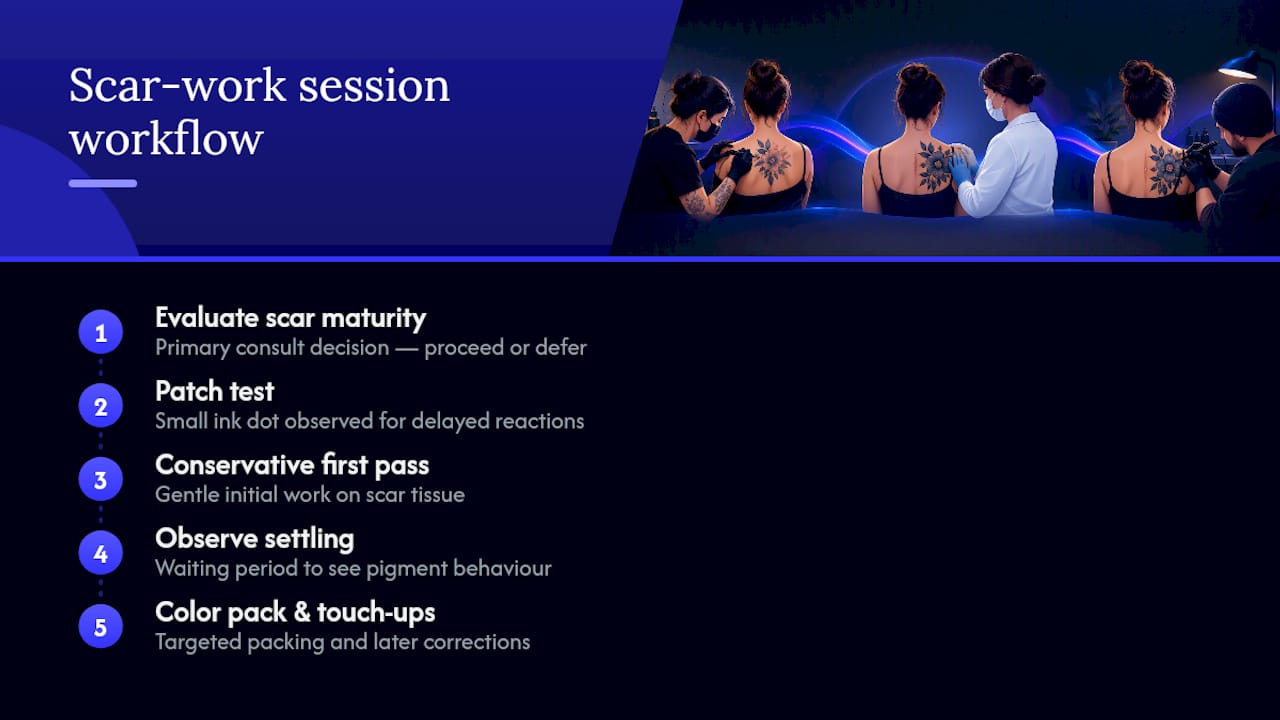
Evaluating scar maturity is the first real decision point in any consult, and it’s usually what determines whether a piece moves forward at all. A patch test, a small dot of ink placed and observed over a set window, catches delayed reactions before they become a bigger problem on a larger piece.
Session planning on scar tissue tends to be staged rather than rushed: a conservative first pass, a waiting period to see how pigment settles, then targeted color-packing and touch-up sessions once the skin’s response is clear.
A scar doesn’t heal on the artist’s schedule. It heals on its own, and the work has to respect that timeline rather than fight it.
That patience is exactly what separates a design that ages well from one that needs constant repair.
Why Clients Choose Scar Tattoos, and Why Patience Matters More Than Speed
Most people who cover a scar aren’t chasing a trend. They’re reclaiming a piece of their body that a hard chapter took from them, and that motivation deserves an artist who treats the process with the same weight the client does. The honest advice is simple: prioritize a practitioner’s skill and safety practices over their price or their turnaround time. A rushed cover-up rarely ages well. A collaborative one, built around what the scar actually means to you, usually does.
— Kyle
Book a Scar Consultation With Soul Kraft Ink
Soul Kraft Ink builds every scar cover-up as an original piece, no templates, no repeats, designed around your scar’s shape, texture, and story rather than forced into a generic layout. The studio’s artists work across color realism, blackwork, and fine line, styles that give you real options depending on whether your scar needs bold camouflage or subtle detail work.
Bring any relevant medical notes and photos of your fully healed scar to your consult so the artist can plan sessions properly, and expect an honest conversation if your scar needs dermatology clearance first. Pricing runs $200 to $300 per hour or $1,200 to $2,000 for a full day session, with a shop minimum of $150 to $200. Start the process through the inquiry form and get your scar assessed by someone who’s done this before.
Where to Verify Scar and Tattoo Safety Information
For deeper reading, the American Academy of Dermatology’s scar guidance covers medical evaluation and timing. The Cleveland Clinic’s micropigmentation page explains camouflage risks, and its aftercare guide covers healing steps. For a broader look at why professional assessment matters after any procedure affecting skin, this guide on correcting post-surgical asymmetry makes a similar case for clinical evaluation before cosmetic follow-up work.
This article is general information, not a substitute for advice from a qualified doctor. Consult a qualified healthcare professional about your own circumstances before acting on anything here.
Sources
FAQ
Can You Hide Scars With Tattoos?
Yes, both decorative cover-ups and paramedical camouflage can visually minimize a scar once it’s fully healed and stable. The technique your artist recommends depends on whether the scar is flat and depigmented or textured and raised.
Is Scarification Illegal in the US?
Scarification, deliberately creating scars as body art, is a separate practice from scar cover-up tattooing and its legal status varies by state and local regulation. Covering an existing scar with a tattoo is standard cosmetic tattoo work and is legal wherever tattooing itself is licensed and regulated.
What Is the Best Tattoo Design to Cover a Scar?
Busy, organic patterns like florals, abstract linework, or texture-heavy blackwork tend to disguise irregular scar surfaces better than fine, delicate line work, since texture can still show through thin lines. The right choice depends on your scar’s color, texture, and size, which is exactly what a consult is for.
How Much Does a Scar Camouflage Tattoo Cost?
Cost depends on scar size, session count, and technique, with paramedical camouflage often requiring multiple sessions to match skin tone accurately. At Soul Kraft Ink, hourly rates run $200 to $300 per hour, with full-day sessions at $1,200 to $2,000, plus a shop minimum of $150 to $200.
Recommended
Comments