
Studio First: Wait 8–12 Weeks to Fix a Tattoo Blowout
Yes, a tattoo blowout can be corrected, but not erased. Once healing finishes, your realistic paths are a cover-up or touch-up, laser correction to fade the blur, or in rare cases surgical excision, depending on factors like size and placement. The first move is always the same: wait for full healing, commonly several weeks, then get a professional opinion before choosing a direction.
TL;DR:
Laser correction can fade tattoo blowouts significantly but often requires multiple treatments spaced six to eight weeks apart, with full results taking up to a year.
Cover-ups are usually the fastest way to hide a blowout, but they may not work well with fine-line or delicate designs, which could need more extensive redesigns.
Surgical excision is only suitable for small, well-positioned blowouts in loose skin, offering a one-time removal but leaving a permanent scar.
The true extent of a blowout often becomes clear only after a full healing period of four to six weeks, especially on thin or high-movement areas.
Prevention relies on choosing experienced artists, proper placement, and diligent aftercare, particularly on thin or reactive skin to reduce blowout risk.
Table of Contents
Tattoo Blowout Fix: What’s Actually Happening Under Your Skin
A blowout happens when a tattoo needle pushes ink past the dermis and into the subcutaneous fat layer underneath. The dermis is where ink is supposed to sit. It’s dense, fibrous, and holds pigment in place for decades. Fat, on the other hand, is loose and mobile, so ink that lands there doesn’t stay put. It spreads outward under the skin, creating a soft, blurred halo around the linework that looks almost like a bruise that never healed right.
This migration pattern shows up in clinical case reports, which describe blowouts as a mechanical placement problem, not an infection or an allergic reaction. That distinction matters for how you think about treatment. You’re not treating inflamed tissue. You’re dealing with pigment sitting in the wrong layer, and that pigment isn’t going anywhere on its own.
A few mechanics worth understanding before you panic about a fresh tattoo:
Ink in fat spreads laterally because fat tissue has looser structure and more movement than dermis.
The blur typically radiates outward from the linework, most noticeably around thin or sharp details.
Once ink settles into fat, it becomes a permanent part of the tissue, just like properly placed ink in the dermis.
Blowouts don’t resolve, shrink, or fade the way normal swelling does over weeks.
A blowout is permanent tissue migration, not a healing complication. That’s the core fact that separates it from ink weeping or temporary swelling, both of which look alarming in week one but disappear entirely as skin settles.
The confusion between blowout and normal healing trips up a lot of people. Fresh tattoos often ooze plasma and excess ink for the first few days. Some areas swell and look temporarily blurred as the skin reacts to trauma. Scabbing can distort lines and make you think detail work was botched. None of that is permanent. A true blowout, by contrast, still shows that soft gray halo weeks after everything else has calmed down, and it doesn’t change shape or intensity from one week to the next once healing is complete.
How Do You Tell a Blowout From Normal Healing?
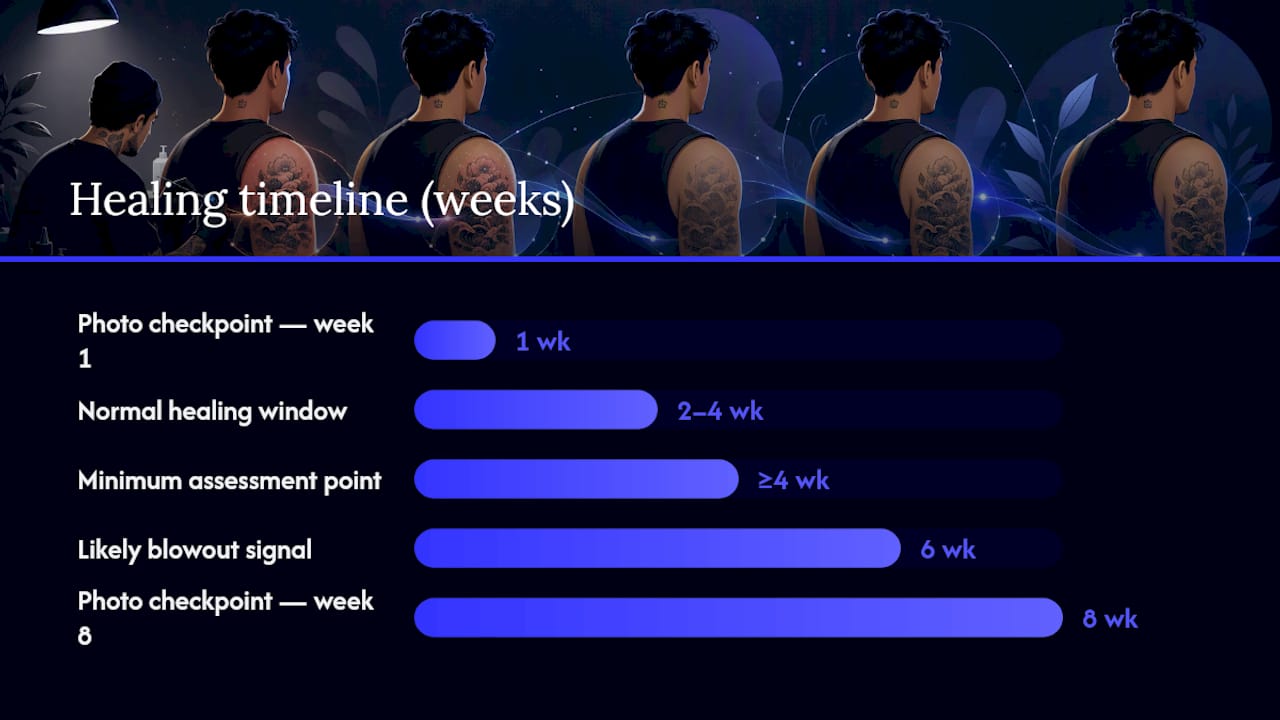
Timing is your best diagnostic tool. Normal healing settles down within two to four weeks. Redness fades, scabs flake off, and any temporary blur from swelling disappears as the skin flattens back out. If the blurring you’re seeing is still there at the six-week mark and looking the same as it did at week three, you’re likely looking at a real blowout rather than a healing artifact.
Here’s a practical sequence for figuring out what you’re dealing with:
Wait through the full healing cycle. Don’t assess anything before four weeks minimum. Skin is still remodeling and normal blur can persist longer than people expect.
Check the pattern. True blowout blur tends to look smoky or feathered, spreading in one direction (often the direction gravity or repeated skin movement pulls) rather than an even halo around every line.
Note the location. Blowouts show up disproportionately on thin-skinned, high-movement areas: the inner wrist, the top of the foot, fingers, and the sides of the ribs. Case documentation has even recorded blowout patterns that only became visible years after the original tattoo, migrating further under gravity over time.
Compare to the original stencil. If lines that were crisp on day one are now fuzzy in the exact same spot, that’s a stronger signal than generalized redness.
Photograph it weekly. Consistent lighting and angle turn a vague worry into evidence a professional can actually use.
Before any consultation, put together a short observation file: photos from week one, week four, and week eight, plus notes on when you first noticed the blur and whether it’s changed shape since. Artists and laser technicians work faster and more accurately with a timeline in front of them instead of a single snapshot taken in a panic.
When Should You Wait Before Getting a Corrective Fix?
Patience is the least exciting advice in tattoo care, and also the most important. Corrective tattooing typically shouldn’t start until eight to twelve weeks after the original session, giving the skin enough time to fully settle and reveal the true extent of any ink migration. Jumping in earlier means working over tissue that’s still changing, which risks a cover-up that looks worse in six months than it did on day one.
Laser correction runs on its own clock. Sessions need six to eight weeks between treatments so the body has time to clear broken-down pigment through the lymphatic system. Rushing sessions closer together doesn’t speed up fading. It just raises the risk of skin damage without any extra benefit.
Roughly six to eight weeks separate each laser session, and full correction often takes several rounds. That single number explains most of the frustration people feel with laser correction. It’s slow by design, not because the technology is failing.
While you wait, a few concealment options can get you through the visible-tattoo phase of daily life:
Color-correcting concealer applied over fully healed skin, never over anything still scabbing or peeling.
Loose clothing or accessories over high-visibility placements like wrists and ankles.
Avoiding sun exposure on the area, since UV light darkens surrounding skin and makes the blur more obvious by contrast.
Avoid tattoo-specific cover sprays or heavy makeup during the first month. They can trap moisture against healing skin and interfere with your artist’s ability to accurately judge the blowout later.
Comparing Your Fix Options: Cover-Up, Laser, and Surgery
Three real paths exist for correcting a blowout, and each comes with its own timeline, cost range, and trade-offs. Additional tattooing and laser removal cover the overwhelming majority of cases; surgical excision stays reserved for a narrow set of small, well-positioned tattoos.
Cover-up and touch-up work
A cover-up uses new linework and shading to visually absorb the blurred area into a larger design. It’s often the fastest route to a finished-looking result, sometimes completed in a single extended session depending on size and complexity.
The catch is design flexibility. Fine-line and minimalist tattoos are the hardest style to correct this way, since a delicate design typically can’t hide a soft gray halo without a significant style shift toward bolder, darker work. Camouflage or skin-toned ink rarely holds a natural appearance over the long term, since skin tone ink tends to shift color as it ages, sometimes turning a visible shade of gray or blue itself.
Cost varies with the artist’s rate structure and how large the corrective design needs to grow to cover the blur. A cover-up billed hourly or as a full session will typically run more than the original tattoo, simply because the artist is solving a design problem on top of applying new ink.
Laser correction and removal
Laser treatment breaks down the migrated pigment using targeted light, most commonly with Q-switched or picosecond lasers depending on ink color and depth. The body’s immune system then clears the fragmented ink gradually over the following weeks.
Expect multiple sessions, not one. Most cases need anywhere from a handful to a dozen or more treatments, spaced six to eight weeks apart, with visible fading building gradually rather than dropping off after a single visit. Per-session pricing depends heavily on the treatment area’s size and the clinic’s location, and total cost across a full course of sessions can add up to more than a new tattoo.
Pro Tip: Ask your laser provider to photograph the treated area under consistent lighting before every session. Fading is often subtle week to week, and side-by-side comparisons over two or three months make progress obvious when it doesn’t feel obvious in the moment.
Surgical excision
Excision means physically cutting out the tattooed skin and closing the wound, an option realistically limited to small tattoos where the surrounding skin has enough laxity to close cleanly. It trades the fading timeline of laser for a single procedure, but it introduces a permanent scar and a real recovery period, and it’s not a fit for large-scale pieces or anywhere skin is already taut.
Cost sits closer to a minor outpatient procedure than a tattoo session, and it typically requires a referral to a dermatologist or plastic surgeon rather than a tattoo studio.
The combination approach
Many of the best outcomes come from combining methods rather than picking one exclusively. A round or two of laser treatment can fade the blown-out pigment enough that an artist has a cleaner canvas to design around, meaning the cover-up doesn’t have to be as large or as dark to fully hide the original blur. This sequencing tends to produce the most natural-looking final result, especially for tattoos where the client wants to preserve a smaller or more delicate aesthetic than a straight cover-up would allow.
Option | Best for | Typical sessions | Scarring risk |
Cover-up/touch-up | Larger, bolder styles; fastest visible fix | Often 1 session | None, but limits future design changes |
Laser correction | Fading before a cover-up, or fading alone | Multiple, spaced 6 weeks apart | Low when performed properly |
Surgical excision | Small tattoos, thick surrounding skin | 1 procedure | Permanent linear scar |
How Do You Choose the Right Fix for Your Situation?
The right option depends on more variables than most people consider before walking into a shop. Run through this checklist before committing to a direction:
How severe is the blur? A faint halo around one section responds differently than pigment spread across a large area.
What style is the original tattoo? Fine-line and single-needle work usually points toward laser-first strategies; bold traditional or blackwork often takes a cover-up well.
Where is it located? Thin-skinned, high-movement spots like wrists and feet may need extra caution and a provider experienced with that anatomy specifically.
What’s your skin tone and type? Darker skin tones need a laser provider experienced in adjusting settings to avoid pigment changes.
How old is the tattoo? A blowout that’s sat for years may have migrated further than a recent one, changing what’s realistically coverable.
What’s your budget and timeline? Laser correction spreads cost over months; a cover-up concentrates it into fewer visits.
How do you feel about scarring or multiple sessions? Be honest here. Excision guarantees a scar. Laser guarantees patience.
When you sit down for a consultation, ask direct questions rather than general ones. For an artist: how many blowout cover-ups have you done, can I see healed photos (not fresh ones) of that work, and what design changes would this specific blowout require? For a laser provider: what type of laser do you use for this ink, how many sessions do you realistically expect for full or partial correction, and what’s the plan if fading stalls after a few rounds?
Pro Tip: Treat “healed photos only” as a hard requirement, not a preference. Fresh tattoo photos hide almost every flaw a blowout consultation actually needs to see.
Red flags worth walking away from: a provider who won’t show healed work, anyone who promises a single-session fix for a widespread blowout, or an estimate that skips discussing your specific skin type and tattoo age entirely. Compare at least two consultations before committing, since experience with cover-up work specifically varies enormously between artists who otherwise have strong portfolios.
Reducing Blowout Risk on Your Next Tattoo
Prevention starts before the needle ever touches skin, and it starts with who’s holding it. Ask any prospective artist to show healed work, not just fresh photos taken minutes after a session, since blowouts often only become visible weeks later. An artist with a track record of clean linework on the specific body area you’re planning is worth more than one with a beautiful portfolio and no healed thin-skin examples.
Placement matters just as much as the artist’s skill. Thin-skinned areas like the inner wrist, fingers, ribs, and the top of the foot carry higher blowout risk regardless of who’s holding the machine, simply because there’s less dermis depth to work with before hitting fat. If you want intricate fine-line detail, consider whether a slightly different placement, like the forearm or calf, gives the artist more room to work safely.
A few practical steps that lower your risk:
Ask your artist directly what needle depth and technique they use for fine-line or single-needle work.
Choose thicker-skinned placements for the most delicate linework whenever the design allows it.
Follow aftercare instructions precisely during the first two weeks, since excess stretching, friction, or moisture can affect how ink settles.
Avoid tattooing over areas with existing scar tissue or unusually thin skin without discussing it first.
Bring up your skin type and any history of blowouts on previous tattoos during the consultation.
None of this eliminates risk entirely. Skin varies person to person, and even experienced artists occasionally see a blowout on a client with unusually thin or reactive skin. But vetting an artist’s healed portfolio and having an honest placement conversation cuts your odds significantly compared to picking based on flash design alone.
How Soul Kraft Ink Evaluates and Treats Blowouts
At Soul Kraft Ink, a suspected blowout starts with a real conversation, not an immediate sales pitch for a cover-up. The first step is always a visual assessment against a healing timeline: how old is the tattoo, what does it look like now versus a month ago, and does the pattern match a true blowout or a slower-than-usual healing process. Bringing photos from multiple points in the healing timeline speeds this up considerably.
From there, the studio maps out design strategy around what the blur actually allows. Some blowouts sit small enough that a moderate cover-up handles them in a single extended session. Others, especially wider spreads on fine-line work, are better served by a laser referral first, fading the migrated pigment before any new ink goes down. That sequencing protects the final result rather than rushing to ink over a problem that hasn’t been properly reduced yet.
A consultation at Soul Kraft Ink walks through the same evidence a laser clinic would want to see: the original design intent, the current state of the blur, and realistic options across the studio’s specialties, from blackwork and color realism to large-scale cover-up design. Clients considering a correction should expect a direct answer about whether their case is a straightforward touch-up, a design-driven cover-up, or a case that needs laser work first.
What Happens During Each Corrective Procedure
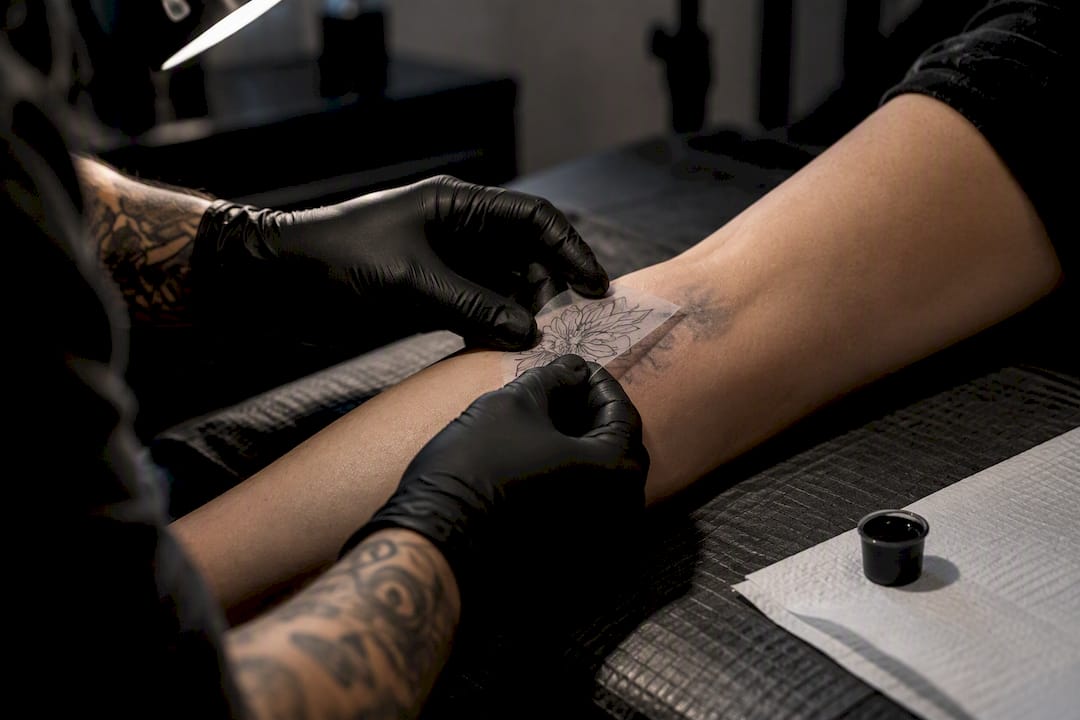
A cover-up session starts with stenciling directly over the healed blowout area, adjusted in real time as the artist gauges how much the new linework needs to shift to hide the blur underneath. The tattooing process itself looks like any other session, just with denser shading or bolder linework layered specifically to obscure the gray halo.
Laser sessions run short, often ten to thirty minutes depending on the treatment area. The technician passes a handheld laser device over the pigment in overlapping passes, and most people describe the sensation as sharp, similar to a rubber band snap repeated quickly. Skin typically frosts white immediately after treatment, a normal reaction as the laser breaks down pigment particles, and that frosting fades within an hour.
Surgical excision happens in a clinical setting under local anesthesia. The surgeon removes the tattooed skin and closes the wound with sutures, a process that typically takes under an hour for a small area. Unlike the other two options, this is a one-time procedure rather than a series, though the surgeon may recommend a follow-up visit to check healing and suture removal.
Recovery and Aftercare for Each Fix
Cover-up aftercare mirrors standard tattoo aftercare: keep the area clean, apply a thin layer of recommended ointment, avoid soaking the skin for the first two weeks, and stay out of direct sun until it’s fully healed. Because a cover-up is often denser than the original tattoo, expect slightly more swelling and a longer initial peeling phase.
Laser aftercare focuses on protecting fragile, treated skin. Keep the area covered and moisturized for the first few days, avoid sun exposure completely between sessions since UV light can cause pigment changes in healing skin, and skip strenuous activity that causes excess sweating for at least 48 hours.
Excision recovery involves suture care, keeping the incision dry and clean, and following the surgeon’s specific timeline for suture removal, usually one to two weeks. Avoid stretching or straining the area during that window, since tension on a fresh incision widens the eventual scar.
Risks Beyond Scarring You Should Know About
Scarring gets most of the attention, but it’s not the only risk on the table. Laser correction carries a real chance of pigment change in the surrounding skin, particularly hyperpigmentation or hypopigmentation in people with darker skin tones, if the laser settings aren’t calibrated correctly for that skin type. Some ink colors, especially certain reds and light pigments, can also paradoxically darken when hit with the wrong laser wavelength.
Cover-up work introduces a smaller but real infection risk, identical to any new tattoo, if aftercare instructions aren’t followed precisely. Working over previously blown-out tissue can also mean the skin heals slightly differently than untouched skin, occasionally leading to uneven ink saturation in that specific area.
Surgical excision carries standard minor-surgery risks: infection at the incision site, delayed wound healing, and in rare cases, keloid or hypertrophic scarring in people prone to it. Anyone with a personal or family history of keloid scarring should raise that directly with the surgeon before scheduling.
How Long Until You See Real Improvement
Cover-up results are visible immediately, though full healing and true final color still take the standard four to six weeks a new tattoo needs to settle completely. What you see the day you leave the chair is close to, but not exactly, the finished look.
Laser correction moves much slower. Meaningful fading usually becomes noticeable after two to three sessions, meaning three to five months into a schedule spaced six to eight weeks apart. Full correction, if laser is the only method used, can take six months to over a year depending on how deep and dense the original migration was.
Excision results are visible the moment sutures come out, roughly one to two weeks after the procedure, though the scar itself continues maturing and fading in appearance for up to a year afterward.
What Real Outcomes Tend to Look Like
A small blowout along a single fine line, caught early and covered with a moderately sized blackwork design, often resolves in one session with a result that reads as intentional rather than corrective. That’s the best-case scenario: contained blur, flexible design options, and an artist who can build around it rather than against it.
A wider blowout spanning a larger area of fine-line or single-needle work usually needs the combination approach. A handful of laser sessions fade the migrated pigment enough that the eventual cover-up can stay closer to the original style’s scale, rather than ballooning into a much larger, heavier design just to hide the spread. That process takes longer, often the better part of a year between laser scheduling and the final tattoo session, but it tends to protect the aesthetic the client actually wanted in the first place.
Cases that reach the excision stage are rare and specific: a small, isolated blowout on an area with enough skin laxity that removing it entirely and closing the wound cleanly is genuinely a better outcome than years of laser sessions or a cover-up the client doesn’t want.
Why Patience Beats Panic With Blowout Corrections
Most of the anxiety around blowouts comes from people trying to fix something before the skin has finished telling them what actually needs fixing. That’s the biggest gap I see between what conventional advice says and what actually helps: everyone tells you to “wait,” but almost nobody explains that the waiting period is diagnostic, not just cautious. You’re gathering the evidence your artist or laser provider needs to make a real recommendation instead of a guess.
The second thing people underestimate is how much the combination approach changes outcomes. Treating laser and cover-up as competing options instead of sequential ones leads to bigger, heavier cover-ups than necessary. A few rounds of fading first almost always buys the artist more design freedom later.
If there’s one priority above everything else, it’s this: find someone who will look at healed photos, not fresh ones, and give you a straight answer about timeline and trade-offs. That conversation matters more than any single technology or technique.
— Kyle
Book a Blowout Consult at Soul Kraft Ink
Soul Kraft Ink treats a blowout consult the way a good diagnosis should work: an honest look at your healing timeline before anyone talks design. The studio handles cover-ups, touch-ups, and full assessment consults in-house, and when laser fading makes more sense first, you’ll hear that directly instead of getting talked into ink that won’t hold up.
Coming into a consult prepared makes the whole process faster. Bring photos from at least two or three points in your healing timeline, note when you first noticed the blur, and write down your questions about design options, session count, or referral needs ahead of time. Pricing for corrective work runs on the same hourly and full-day session rates as any custom piece, with a shop minimum applied to smaller touch-ups. Browse healed portfolio work across styles before your visit so you walk in with a clear sense of what a cover-up in your preferred style could look like, then reach out through the inquiry page to schedule an in-person assessment.
Sources
FAQ
Can Tattoo Blowouts Be Fixed?
Yes. The most common tattoo blowout fix is a cover-up or touch-up once the tattoo has fully healed, and laser correction can fade the migrated pigment beforehand for a cleaner result. Surgical excision remains an option for small tattoos where scarring is an acceptable trade-off.
Are Tattoo Blowouts the Artist’s Fault?
Not always. Blowouts often result from a combination of needle depth, angle, and how thin or reactive an individual’s skin is in that specific area, and thin-skinned locations like the wrist or foot carry higher risk regardless of technique. Choosing an experienced artist with strong healed-work portfolios lowers the odds significantly, but skin variation means it isn’t purely a skill issue.
Can You Get Rid of a Tattoo Blowout Completely?
Laser treatment can fade a blowout substantially over multiple sessions spaced six to eight weeks apart, but full removal without any visible trace isn’t guaranteed. Most people combine laser fading with a cover-up for the most complete visual correction rather than relying on laser alone.
Can Tattoo Blowouts Disappear on Their Own?
No. Ink deposited into the fat layer stays there permanently since it’s outside the skin’s normal turnover process. What can disappear on its own is temporary swelling or ink weeping from fresh healing, which is often mistaken for a blowout in the first few weeks.
How Much Does a Tattoo Blowout Fix Cost at Soul Kraft Ink?
Corrective work at Soul Kraft Ink is billed under the same hourly and full-day session rates used for any custom tattoo, with a shop minimum applying to smaller touch-ups. Exact pricing depends on the size and complexity of the correction, so a consult is the best way to get a specific estimate.
Comments