
Wait 6 Months to 2 Years: Artist's Plan to Tattoo Over Stretch Marks
Yes, tattooing over stretch marks is usually possible once the marks have matured, though the skin’s texture and healing pattern change what you get. Ink often anchors unevenly on scar tissue, so expect slightly more pain, a design built to work with the marks rather than erase them, and a planned touch-up. Success depends heavily on the artist’s experience with textured skin. A consultation with healed photos should come before anything else.
TL;DR:
Tattooing over mature stretch marks can improve the appearance by blending discolored streaks into a cohesive design, but it will not erase the texture or ridges.
Success depends on waiting until marks turn pale and stop changing color, which can take six months to two years, and preparing the skin properly beforehand.
Organic styles like botanical, watercolor, and dotwork work best, as they disguise uneven textures and pigment irregularities, while fine lines and geometric shapes highlight surface inconsistencies.
Discomfort during tattooing over stretch marks is generally moderate and can be reduced with numbing creams and slower session pacing, but longer, multiple sessions are often necessary.
Proper healing involves patience, with potential patchiness and longer time for color settling, and touch-ups are a common part of the process, especially on textured skin.
Table of Contents
Why Stretch-Marked Skin Behaves Differently Under the Needle
Stretch marks, medically called striae, are a form of dermal scarring. The collagen and elastin fibers in the skin stretch, tear at a microscopic level, and rebuild in a disorganized pattern, leaving the dermis thinner than the surrounding skin and giving the surface that ridged or silvery texture you can feel with a fingertip.
That structural change matters once a needle enters the picture. Ink normally sits in the dermis in a fairly predictable band. On stretch-marked skin, the disrupted fiber structure changes how deposited pigment settles and heals, which can mean uneven retention, slight pigment migration, or patches that heal lighter than the rest of the piece.
That leads to a distinction every client needs to understand before booking:
A tattoo can camouflage the color of a stretch mark, blending its lighter or discolored streaks into a design.
A tattoo generally cannot erase the texture. Raised or indented ridges usually stay palpable and sometimes visible under certain light, even through solid ink coverage.
Wider, deeper stretch marks (common after significant weight change or pregnancy) tend to hold onto some visible ridging no matter how skilled the artist is.
Thin, shallow, faded marks integrate most seamlessly into color fields and shading.
Set the expectation early: you’re not buying a disappearing act. You’re buying a design that makes the marks part of the art instead of the focal point.
When Is the Right Time to Tattoo Over Stretch Marks?
Timing is the single biggest variable in how well a tattoo covers stretch marks, and it’s also the one people rush the most. Fresh, actively changing marks are a poor tattoo surface.
Check the color first. Red, purple, or pink marks (called striae rubra) are still inflamed and actively remodeling. Tattooing over them risks poor ink uptake and unpredictable healing. Wait.
Confirm the marks have gone pale or silver. Mature marks (striae alba) have stopped changing color and are the more reliable candidates for tattoo work. This shift commonly takes anywhere from 6 months to 2 years, depending on the person and the size of the mark.
Note texture separately from color. Raised or indented marks can be pale and still present more technical difficulty than flat, faded ones. Mention this to your artist during consultation.
Prep the skin for weeks before your appointment. Daily moisturizing, avoiding sun and tanning beds, and keeping your weight stable in the run up to the session all help the skin behave more predictably under the needle.
Bring unedited, well-lit photos to your consult. Filtered or heavily edited photos hide exactly the detail your artist needs to see.
Rushing this step is the most common regret in stretch-mark tattoo work. Waiting an extra few months costs nothing. A tattoo that heals poorly over immature scarring costs a redo.
What Tattoo Styles and Techniques Work Best Over Stretch Marks?
Design choice does more heavy lifting here than almost anything else in this process. Some styles hide texture and uneven pigment beautifully. Others make every ridge and pigment inconsistency stand out.
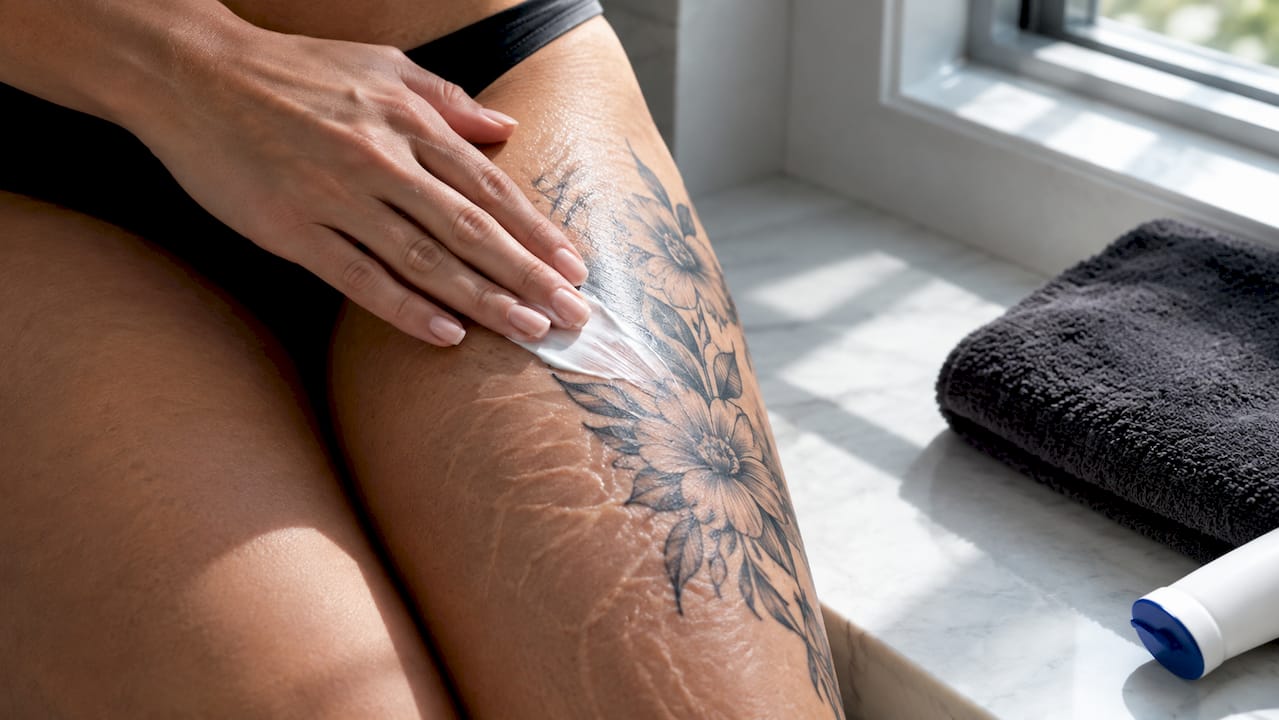
Botanical work, flowing ornamental patterns, watercolor style backgrounds, and dense dotwork tend to perform best. Their organic, busy compositions disguise the direction and depth of stretch mark bands instead of fighting them. A cluster of florals with layered shading can absorb a band of striae into its shadow lines almost invisibly, especially once fully healed.
Fine-line work and tight geometric designs sit at the other end of the spectrum. A single crisp black line drawn across textured skin has nowhere to hide. It highlights every dip and ridge instead of covering it, and thin lines are more prone to blowing out or blurring on disrupted collagen.
Botanical and floral compositions with varied line weight
Watercolor style backgrounds that use gradient rather than solid edges
Dense dotwork or stippling that breaks up the eye’s read of the surface
Ornamental mandala or filigree work with layered depth
Avoid: single fine lines, minimalist geometric shapes, or anything relying on one crisp edge
Skilled artists also change technique, not just design. That means micro-adjusting needle depth as they move across thicker and thinner sections of a mark, leaning on shading and solid color fields instead of single outlines, and working with the direction the marks run rather than cutting across them.
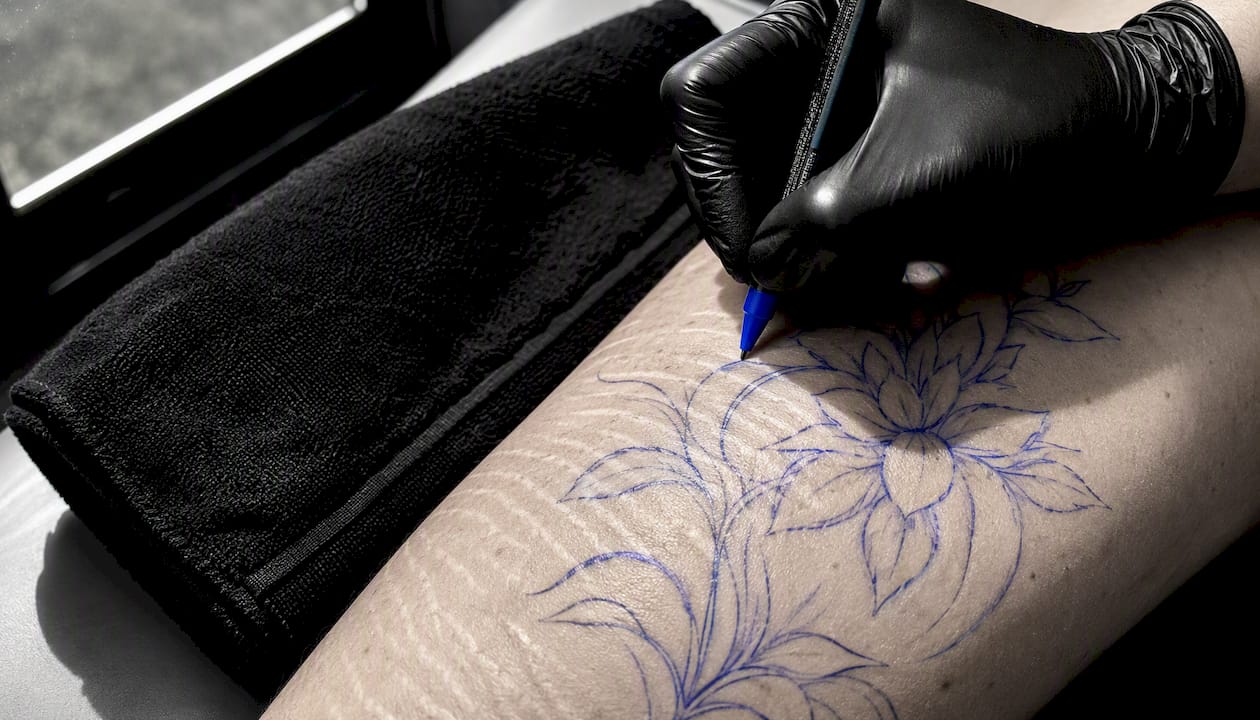
Pro Tip: Ask your artist to sketch the design directly onto your skin before the session and photograph it in different lighting. Stretch marks catch shadows differently than flat skin, and what looks great under studio lights can read differently in daylight.
Does Tattooing Over Stretch Marks Hurt More?
Most clients report tattooing over mature stretch marks feels more sensitive than tattooing the surrounding unmarked skin, largely because the disrupted nerve patterns in scar tissue respond differently to repeated needle contact. Anecdotal reports commonly put the discomfort in the 5 to 7 range on a 10-point scale, noticeably above flat skin in the same area but nowhere near as intense as tattooing over fresh or actively inflamed marks, which most artists won’t do anyway.
A few things shape how a session actually feels and moves:
Topical numbing creams are common for larger stretch-mark pieces and can meaningfully reduce discomfort during longer sittings.
Artists often pace work more deliberately over textured skin, working in shorter passes and checking in more frequently than on unmarked areas.
Sessions over dense stretch-mark coverage sometimes run longer than a comparable piece on flat skin, simply because of the needle depth adjustments involved.
Large-scale coverage is frequently split into multiple sittings, both to manage sensitivity and to let the artist assess healing between passes.
Built-in rest breaks mid-session are more common on this kind of work than on standard tattoo appointments.
None of this should scare you off. It should just recalibrate what “normal” looks like for this specific type of tattoo.
How Does Healing and Touch-Up Work After a Stretch Mark Tattoo?
Healing over stretch-marked skin doesn’t always follow the tidy, predictable timeline you’d expect from a tattoo on flat skin. Peeling can be patchier, some areas may look lighter than others as scabbing lifts, and the final settled color sometimes takes longer to reveal itself fully.
Days 1 to 3: Keep the area clean with gentle, fragrance-free soap and pat dry. Expect some oozing and redness, more pronounced in areas with deeper texture.
Days 4 to 14: Peeling and light flaking begin, often unevenly across raised versus flat sections. Moisturize consistently with a thin layer of fragrance-free lotion.
Weeks 3 to 6: Color settles. Patchy or slightly faded spots at this stage are common and not necessarily a final result.
Weeks 6 to 12: This is the typical window for the follow-up touch-up, when artists correct any spots where ink dropped out during healing on the stretch-marked areas.
Budget for that touch-up from the start. It’s a standard part of stretch-mark tattoo work, not a sign anything went wrong, and many studios build the first one into the original quote or estimate it up front during consultation.
Sun exposure is the other long-term variable. Daily SPF 30 or higher over healed tattoos slows fading significantly, and that matters even more on stretch-marked skin, where uneven pigment is already a risk without adding UV damage on top of it. Avoid stretching the skin aggressively (think intense ab workouts right over a fresh belly piece) while it’s still settling in those first few weeks.
What Are the Risks and When Should You See a Doctor First?
Not every stretch mark, and not every body, is ready for a tattoo the moment the marks turn pale. A handful of medical factors change the calculus, and skipping them is where most bad outcomes start.
Never tattoo active, inflamed, broken, or infected skin, regardless of how mature the surrounding marks look.
Disclose any history of keloid scarring. Keloid-prone skin carries a higher risk of raised, thickened healing and deserves a frank conversation with your artist, and possibly a dermatologist, before booking.
Flag immunosuppressant medications or a recent course of isotretinoin (commonly known by the brand name Accutane). Both can significantly impair how skin heals and typically call for medical clearance first.
Watch for spreading redness, warmth, pus, fever, or pain that worsens instead of improving after the first few days. These are infection signs that need a doctor, not just your artist.
If you’re managing a chronic skin condition or diabetes, mention it at consultation. Healing time and risk both shift with these factors.
When in doubt, a quick check-in with a dermatologist before your appointment costs far less than dealing with a complication after.
How Do You Choose the Right Artist for Stretch Mark Tattoos?
Not every skilled tattoo artist has real experience with textured, scarred skin, and that experience is exactly what separates a design that camouflages stretch marks from one that just sits on top of them.
Ask to see healed photos, not fresh ones, of past work specifically over stretch marks or scarring. Fresh tattoos always look sharper than they’ll settle.
Ask how long after healing those photos were taken. Three weeks post-heal looks very different from six months.
Confirm the studio’s touch-up policy upfront: is a follow-up included, and roughly when does it happen?
Ask directly what technique adjustments they make for textured skin and whether they use numbing products for longer sessions.
Bring your own recent, unedited photos and disclose relevant medical history without downplaying it.
If you’re planning a pregnancy, a significant weight change, or another body change in the near future, say so. It affects both design placement and timing advice.
Pro Tip: During consultation, ask the artist to run a finger over the marks with you and talk through, out loud, which sections they expect to hold ink well and which might need extra attention. Artists who can’t answer that specifically probably haven’t done much of this work.
What Are the Alternatives to Tattooing Over Stretch Marks?
Tattooing isn’t the only route to less visible stretch marks, and it’s worth knowing the alternatives before committing to a permanent design.
Makeup and specialized body concealers offer a temporary, zero-commitment option. Color-correcting concealers can neutralize the reddish or purplish tone of newer marks for a single event, though they wash off and won’t hold up to swimming or heavy activity.
Laser treatments, including fractional lasers and pulsed dye lasers, are a common clinical option for reducing the visible redness or improving texture of stretch marks over a series of sessions with a dermatologist. Results vary by skin tone, mark age, and the specific laser used, and this route typically takes multiple appointments spread over months rather than a single visit.
Topical treatments like tretinoin creams and various oils are widely marketed for fading newer marks, though results tend to be modest and are most noticeable on marks that are still in their reddish, early stage rather than fully matured ones.
None of these erase stretch marks entirely, and none of them are permanent transformations the way a tattoo is. If what you actually want is to stop noticing the marks every time you look in the mirror, a tattoo remains the only option that turns the marks into something you chose, rather than something you’re managing or covering up temporarily.
A Tattoo Artist’s Honest Notes on Stretch Mark Work
Most disappointment with stretch-mark tattoos traces back to mismatched expectations, not bad artistry. Clients want the marks gone. What a well-executed tattoo actually delivers is the marks absorbed into something intentional, with texture that may still be felt under a fingertip even after the color reads beautifully.
At Soul Kraft Ink, every stretch-mark piece starts as a custom design built around where the marks actually run, not a stock template stretched over them. That means longer consultations, more honest conversations about texture, and healed photos shown before any of the flattering, fresh-ink pictures. Touch-ups get discussed on day one, not treated as a surprise six weeks later. The clients who end up happiest are the ones who came in wanting art, not erasure.
— Kyle
Ready to Talk to an Artist About Your Stretch Marks?
If you’ve read this far, you already understand that stretch-mark tattoos take more planning than a standard piece, and that’s exactly the kind of project Soul Kraft Ink is built around. Every design here is custom work, drawn specifically for your body and your marks rather than pulled from a template, which matters more on textured skin than almost anywhere else.
A consultation is the right next step, not a leap of faith. Bring your unedited photos, ask about healed results, and talk through touch-up timing before anything gets sketched. Sessions run $200 to $300 per hour or $1,200 to $2,000 for a full day session, depending on scope, with a shop minimum of $150 to $200. Browse the full portfolio and artist styles to see which artist’s approach fits your vision, then reach out through the inquiry page to start the conversation.
Sources
For deeper detail beyond this guide, Cleveland Clinic’s overview of stretch marks covers the dermatological basics. Tattooing 101’s piece on scar tissue breaks down technique adjustments artists make. The Prevent Cancer Foundation’s tattoo sun-protection guidance is worth bookmarking for long-term aftercare. If your medical history is complicated, talk to a dermatologist before booking rather than relying on general guides alone.
This article is general information, not a substitute for advice from a qualified doctor. Consult a qualified healthcare professional about your own circumstances before acting on anything here.
FAQ
Can You Get a Tattoo on Your Belly to Cover Stretch Marks?
Yes, belly stretch marks are among the most commonly tattooed, especially after pregnancy, once the marks have matured and stabilized in color. Flowing designs like botanical work or ornamental patterns tend to blend abdominal striae more effectively than fine-line pieces.
What Does a Tattoo Over Stretch Marks Look Like?
A well-designed tattoo over mature stretch marks generally looks like a cohesive piece of art with the marks folded into shading, color transitions, or pattern lines rather than standing out as separate streaks. Some texture may still be visible or felt under a fingertip even when the color coverage looks seamless.
How Did Kim Kardashian Get Rid of Her Stretch Marks?
Public reporting has linked her approach to a combination of topical treatments and in-office cosmetic procedures rather than tattooing, though exact specifics of any celebrity’s treatment plan aren’t independently verified. Tattooing remains a separate, permanent alternative for people who want the marks incorporated into a design rather than clinically treated.
Is Scarification Legal in the United States?
Scarification exists in a gray legal area that varies significantly by state, and it is a distinct practice from tattooing, involving deliberate scarring rather than ink deposit. It is not something Soul Kraft Ink offers or something this guide covers as a stretch-mark solution.
How Much Does a Stretch Mark Tattoo Cost?
Pricing depends on size, style, and session length rather than a flat rate. At Soul Kraft Ink, hourly work runs $200 to $300 per hour, with full day sessions between $1,200 and $2,000, plus a shop minimum of $150 to $200.
Comments